


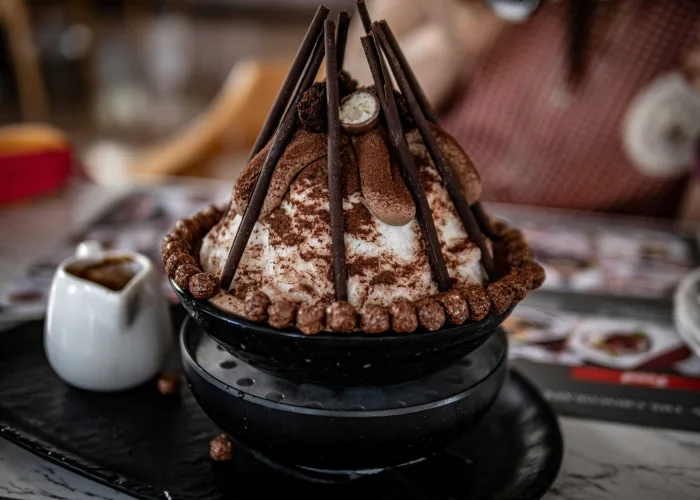
Asia boasts a number of delicacies and savory delights. But this region is not one to back down from its dessert game. A beloved treat across Asia, shaved ice desserts have long been a crowd favorite, whether a treat during the summer or just a special, refreshing indulgence.
In this article, we explore some of the most popular frozen treats in Asia, from South Korea’s ever-popular Bingsu and the Philippines’ iconic Halo-Halo to Taiwan’s creamy Bao Bing and beyond. Get ready to dig in with these mouth-watering desserts, all rich in flavor and culture — packed with flavorful toppings, refreshing textures, and everything in between.
Bingsu (South Korea)

Bingsu is a milk-based Korean dessert made from ultra-fine shaved ice, with every spoonful offering a melt-in-your-mouth sensation. And it just so happens that each serving is an Instagram-worthy confection, topped with a satisfying sweet delight.
Toppings may vary (from fruits, tea powders, cheesecakes, fresh mango, and often a layer of sweetened condensed milk), though the most popular variety of Bingsu is Patbingsu, a version topped with red bean paste. Of course, it all depends on one’s personal taste. Luckily, Bingsu offers just enough variety to please every palate. Over the years, the South Korean dessert has spawned several new flavors, including yogurt Bingsu, milk tea Bingsu, and even Bingsu topped with ice cream.
Kakigōri (Japan)

Japan is home to various sweet treats, including the likes of Taiyaki, Manju, and Dorayaki. This also includes Kakigōri, a traditional Japanese dessert that features finely shaved ice topped with sweet syrups and seasonal ingredients. Much like Bingsu, Kakigōri is also often flavored with condensed milk.
The ice is intended to be finely shaved to give it a snow-like consistency, complete with a variety of flavored syrups, depending on your liking. What sets it apart is its smooth, almost velvety texture.
Bao Bing (Taiwan)

Bao Bing is a popular summer dessert in Taiwan that you can customize with toppings of your choice. Similar to Kakigōri and Bingsu, this frosty treat features finely shaved ice and is topped with a variety of ingredients, from sweet to savory.
The most popular version of Bao Bing is the mango Bao Bing, drizzled with condensed milk. Common ingredients include taro balls, watermelon, strawberries, sweetened red beans, tapioca pearls, grass jelly, and other sweet treats. Some also serve Bao Bing with an added scoop of ice cream for an extra touch of sweetness.
Halo-Halo (Philippines)

The Philippines also offers some of the most beloved shaved ice desserts like Mais Con Yelo, Saba Con Yelo, and Ice Scramble. But the most famous of them all is Halo-Halo. While the others may include ingredients like banana, sweetened red beans, and jelly, Halo-Halo said, “yes.” And it combined them all.
Halo-Halo is a mishmash of ingredients, which perfectly explains its name; halo-halo means “mix-mix” in Tagalog. It’s a vibrant blend of various ingredients, often including jackfruit, banana, leche flan, red beans, ube (purple yam), coconut strips, pinipig, sago, taro, and more. Some versions also include a scoop of ice cream on top. A sweet mess, if you will.
Nam Kaeng Sai (Thailand)

Thailand’s very own shaved ice dessert is called Nam Kaeng Sai, a refreshing treat consisting of a combination of ingredients like tropical fruits, sweet syrup, condensed milk, and various jellies. While it’s considered simpler than its counterparts, this dessert offers a satisfying coolness during the summer.
Some toppings include crushed peanuts, sweet corn, tapioca pearls, jackfruit, and mung beans. Over the years, this famous Thai dessert has also inspired different versions. It’s often served with a drizzle of coconut milk to give it a more refreshing flavor.
Es Campur (Indonesia)

A beloved shaved ice dessert in Indonesia, Es Campur (which means “mixed ice”) is a cooling treat for the country’s tropical weather. It features shaved ice combined with sweet syrups, condensed milk, tropical fruits, avocado, grass jellies, sweet corn, melon, tapioca pearls, coconut, and more.
Its splash of coconut milk and/or condensed milk gives it a creamy finish, making every bite delightful. A perfect way to cool down on a hot day, Es Campur offers a refreshing burst of flavors.
Chè Ba Màu (Vietnam)

A traditional shaved ice dessert in Vietnam, Chè Ba Màu — meaning “three-colored dessert” — consists of three distinct layers, typically featuring pandan jelly, mung beans, and red beans. These colorful layers are then generously topped with creamy coconut milk.
The layers add a balanced harmony that manages to be both refreshing and comforting. It’s often served in a tall glass, allowing consumers to admire the vibrant colors and savor the flavors one by one.
Cendol (Malaysia)

A refreshing escape from the tropical heat, Cendolis a traditional dessert in Malaysia, served with shaved ice and green, worm-like pandan jelly noodles. It is topped with pandan leaf extract, giving it that satisfying fragrance. But make no mistake, this one is also known for its vibrant flavor.
It is generously drizzled with coconut milk and gula melaka (palm sugar), balancing both sweet and earthy flavors. A staple in Malaysian street food culture, Cendol embodies the perfect harmony of tradition and refreshment.